4 Feb

The X-COM Series

Filed under: PC Games No comment

Stepping out of the transport is usually one of the most dangerous moments in the game for your soldiers.

Steam had the entire X-COM collection on sale for a measly US$2 over the weekend and I bought it despite knowing that I most likely will not make a serious effort at actually playing any of the five games in the collection. This is because the first, and widely considered the best, game in the series, UFO: Enemy Unknown (the names are a bit confusing because the games were sold as UFO in the UK but X-COM in the US) was first released in 1994. This means that I first played it when I was 18 years old, and darn if I don’t still remember it as one of my best gaming experiences ever.

Sixteen years later while the core gameplay is as good as ever, the graphics are a muddy mess and most importantly, user interfaces have improved by leaps and bounds since then. This is why as much as I love the game, it’s hard to replay it now. While I can just about stomach the graphics, it’s too much work nowadays to do trivial stuff like manage the inventory levels of your soldiers’ ammunition, to flip between different screens to manufacture stuff and look up their stats etc. The game seriously needs streamlined management screens, right-click mouse functionality and lots of mouse-over tool-tips.

Read the rest of this entry »

31 Jan

Galaxy Trucker + The Big Expansion

Filed under: Boardgames No comment

I played Galaxy Trucker again on Friday night, asking Sean to add in stuff from the Big Expansion this time around. I ended dead last by a significant margin and had to endure much jeering from both my wife and Sean. This was because two of my own Evil Machination cards ended up hurting me more than them, especially in the last flight where I had to pay for 24 broken components! Shan actually built smaller and simpler ships than me but still did better. I still enjoyed the game and I think I’d like to buy it eventually, but it sure is expensive for not a very complicated game.

Some thoughts:

  • Adding all of the stuff from the expansion all at once was probably a bad idea. Both Shan and me had a tough trying to remember what all the new component tiles did while trying to build our ships to take into account the Evil Machination cards and the special rules for some of the ship boards.
  • I really like the variety of ship boards in this game. Yeah, you’re still building your ship using the same pile of components but the different ship boards do add lots of interesting and unique challenges to the layout. Stuff like ships that can be turned to face any direction and having two ships flying side by side are fun!
  • I’m a bit lukewarm on the Evil Machination cards. As it turns out, not all of them are that evil and I feel that they are far too random and their effects vary so much that having one of them show up feels completely arbitrary. One of the cards Shan played simply gave a payout based on the flight order.
  • I like the Rough Road cards. Their effects can be huge as well but at least you get to see them before you start building your ship so you can plan for them. One card we got gave each of us a pool of tiles each that we had to use as much of as possible. That was fun and felt like a unique variant of the original rules, even though I did the worst of us three. One of the cards that we drew seemed like it would be a big deal. It allowed the ships at the back to shoot the ships in front. But it turned out not to matter too much as except during take-off, only the second ship could shoot at the first ship and only when a new ship became first. It would have a bigger effect all the ships at the back could shoot whenever any ship changed position.
  • Since the Big Expansion stuff is supposed to make it much harder for the ships to survive the flight at all, it seems to me that engines are less valuable than other stuff like guns and shields. If so, obviously the aliens that boost engines are devalued as well. I remember that in our first game without the expansion, using the engines to jockey for position in order to be the first to arrive at planets with cargo and to arrive at the destination for the cash payout, was quite important. But since even being able to arrive is going to be tough, it makes more sense to make sure that you have enough guns and shields to survive the trip before thinking about putting in engines.
  • Playing this with more players would probably be more fun. I understand that a maximum of five players is possible using the expansion. Since building the spaceships is simultaneous, it wouldn’t make the game much longer and having lots of people grabbing stuff from the common pile of components would become more hectic and hence, fun. It would also increase the chances of something truly catastrophic happening, providing entertainment to all.
  • Euro-games have a reputation for being non-confrontational and being multi-player solitaire games. Theoretically players should not get too upset when they lose due to the impersonal nature of such games. I’d say Galaxy Trucker counts squarely as a euro-game, but despite fitting both descriptions, it would be a very bad game to play for someone who gets upset about losing games. I can very easily imagine someone crying or throwing a fit of rage if their ship gets blown up. Despite the toy-like aspect of this game, I really don’t think that you should let children play this game unless you really hate the child or something.

When I talk about games, I like to refer to the quote from Sid Meier about games being a series of interesting decisions. Plus Hiew likes the Reiner Knizia quote about games being fun when you play to win. I don’t think either of these quotes is true for Galaxy Trucker. After all, there were times when I could have earned a better score by giving up and selling my goods for half price, but where’s the entertainment value in that? It’s not deep or cerebral, but it manages to hit all sorts of emotional high notes over the course of a session, and that makes it a great game.

28 Jan

Solium Infernum

Filed under: PC Games No comment

Even the map displays borders and different legions in an unusual manner, making it hard to read at first but quite distinctive.

Cryptic Comet’s first game, Armageddon Empires, was an impressive effort, combining CCG-like mechanics with a hex-map based wargame. Not bad for a game made by what is basically a one-man shop, namely QT3 regular Vic Davis. His second game Solium Infernum has been two years in the making and while it’s also a turn-based strategy game played on a hex-map with a design that’s very reminiscent of boardgames, it’s very, very different from the first one.

The most obvious difference is the change in theme. Armageddon Empires was set in a post-apocalyptic world featuring factions inspired by science-fiction. Solium Infernum is set in hell and all the players are archfiends vying against each other for the right to sit on the Infernal Throne left vacant by Lucifer. The most important difference however is that Armageddon Empires was strictly single-player only while Solium Infernum really shines only in multi-player games. You can play it in single-player but the AI currently isn’t smart enough to fully exploit the game’s complex ruleset.

Read the rest of this entry »

25 Jan

Race for the Galaxy

Filed under: Boardgames No comment

I have to sheepishly admit that one of the reasons why I was first interested in Race for the Galaxy was because it’s the most played game ever by Hiew and I thought,  “Hey this guy plays a lot of games, so this must be good, right?” Plus, as I’ve mentioned in an earlier post about Dominion, I really like card-based games and I’m always curious about innovative game mechanics that designers come up with to do more stuff with cards. Then add the advantages that it’s a relatively cheap game, is quick to set up and play and has specialized rules for playing with two people.

Some thoughts I have about its design:

  • Cards serve multiple roles. In addition to being played normally, they are also used as “money” to pay for cards that are being played and to serve as trade goods on planets. Actually using counters to represents goods on planets would work just as well as using cards and the only advantage left is that you can play the game without using too much paraphernalia. But the expansions seem intent on adding more stuff than just cards, which sort of nullifies this advantage. Using the cards themselves as money is a genuinely interesting idea though and eliminates the issue of having “duds” in your hand, cards that you will never play but are stuck with. Just spend them to make them go away!
  • Uses lots of iconography. This raises the difficulty of the initial learning curve but makes it possible to implement many different effects on the cards without filling them with walls of text. Not everything is relayed only through the icons of course and there’s still explanatory text where needed, but the game strikes a good balance I think. Another observation I have is that because I have a slight red-green color blindness, games that make extensive use of colors often confuse me but I’ve never had this problem with Race for the Galaxy.
  • Cards do lots of things! Many cards do one thing in a given phase and a different thing in another phase, made possible by the above-mentioned liberal use of iconography. This creates more possibilities for different types of combos using only a limited pool of cards. Very impressive!
  • It’s at heart a combo-making game, giving you points for successfully assembling cards that work well together. That’s one of the oldest game designs in the world. Think of games like Poker or Mahjong. But Race for the Galaxy still feels fresh and interesting despite this.
  • Has significant randomness given that you depend a lot on the luck of the draw. But the game gives you so many tools that I don’t really feel constrained by it. You have access to two different types of Explore actions to go searching for cards. You can sell trade goods to draw lots of cards. Many card effects allow you to draw more cards whether through the Explore actions or the Trade action.
  • The central role selection mechanic is much weaker than its predecessor Puerto Rico, I feel. In the previous game, choice of role is greatly affected by turn order, which basically means the order than the players sit around the table. In Race for the Galaxy, actions are mostly simultaneous so you don’t really need to consider turn order when choosing action cards. This greatly reduces the amount of interaction in the game but then the mechanic in Puerto Rico can be a bit cheesy as well, so I’m not sure whether this is overall good or bad. I think I should try to play Puerto Rico more especially now that it’s the number one game again on BGG.
  • Fantastic art! Actually, some of the best that I’ve ever seen in any game. I not only like the art, which is full of small details that fleshes out the world the game is set in, but I like the art direction as well. Many games go for showy, dramatic art, but the art for this game goes for a realistic, even understated style. They don’t depict great heroes or fantastical space vehicles, they depict the universe of the game itself, hinting at how much more there is than what it is that we can see. I note that the rulebook states that its setting is inspired by the stories of Frederik Pohl and David Brin. Awesome!
  • The theme is only weakly related to the gameplay however. At heart it is still a Victory Point-chasing Eurogame with a very strong solitaire playstyle, so the theme is just window dressing. For all the cool cards you lay down, you never really get the sense that you’re sending out brigades of space marines to conquer worlds or producing consumer goods to sell to the galaxy at large. It’s all still rather abstract.

All this makes it a game that I’m very happy with. Often when I play games I’ll think, “This is neat but I bet I could have thought of the idea myself”. The design of Race for the Galaxy however strikes me as something that I’d never be able to come up with in a million years. One potential downside is that I suspect that playing it with two players and consequently being able to play two action cards every turn, results in a drastically different version of the game than the normal one using only one action card per player per turn. I really ought to try playing it with more players, but the inherent complexity and heavy use of iconography makes it difficult to teach to new people.

20 Jan

Mirror’s Edge

Filed under: PC Games No comment

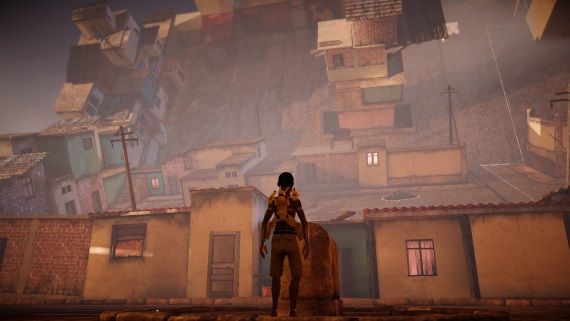
There’s nothing quite like hurtling down a zip line over a hundred meters above the ground and timing your fall for just the right moment.

Mirror’s Edge generated some good buzz when it was first announced with its very unique list of features: a parkour action game in an immersive first-person view, a dystopian city setting with a distinctive aesthetic, even a protagonist that plays against video-gaming stereotype. Faith is a Eurasian girl with a slight build (meaning small boobs) and wears a utilitarian vest with cargo pants rather than bikini armor or other such ridiculous garb. Unfortunately, critical opinion turned negative when it emerged that the impressive cityscape is mostly for show as Faith’s path through the game is linear and contrary to expectations, there are areas where it is practically impossible to get past without resorting to combat.

Since I’m not generally into racing or pure action games, I never planned on buying this. But a year after its release, I noticed during the Christmas season that Steam had it on sale for a mere US$5.00 so I snagged it just to see what it’s like. The good news is that it’s every bit as unique as it promises. Mirror’s Edge is at heart a racing game, except that you’re on foot instead of inside a vehicle and you run across rooftops and through buildings instead of a racetrack. All this is done through a first-person only perspective as well, which is unusual as most action games of this type use a third-person perspective.

Read the rest of this entry »

17 Jan

Shogun

Filed under: Boardgames 5 comments

The gaming group at Carcasean, minus Sean who’s taking the photo.

Shogun has earned a notorious reputation in my local gaming group as the game, together with its older brother Wallenstein, that one of our regulars absolutely refuses to play. Sean seemed enthusiastic about it and we were curious about what kind of game would elicit such an exaggerated reaction in Chee Wee, so a session was duly organized. The game is played on a board that represents Japan in the Warring States period during which the players represent various daimyo vying for the title of shogun. While it has armies and fighting, Sean kept insisting that it wasn’t a wargame and shouldn’t be thought of as one.

The reason for this is that players have a specific number of actions each round and while there are ten actions in total, only two of them allow attacks. Since there are only six rounds in the game during which actions are possible, that means each player can perform at most twelve attacks over the course of the entire game. Of the remaining actions, three enable construction of buildings that earn victory points, another three allows raising troops by spending money, one involves taxing a province to gain cash and the last one involves grabbing rice from the peasants of a province.

Read the rest of this entry »

13 Jan

Gratuitous Space Battles

Filed under: PC Games No comment

A Rebel fleet arrayed for battle.

This was one of the games I picked up for cheap during the Christmas sales on Steam. It’s made by Cliff Harris of Positech Games, who’s a QT3 regular notorious for his anti-piracy tirades, but this is the first game of his that I’ve bought. Gratuitous Space Battles is a game about combat between opposing fleets of starships. There’s no grand strategic layer here. Two fleets meet on what is essentially a 2D battlefield seen from a top-down view and one fleet flies away as the victor.

What sets this game apart is that you don’t even get to control the individual ships directly. Instead you spend most of your time on the ship design screen, picking hulls from one of three classes, fighter, frigate or cruiser, and outfitting it with the modules and weapons you want. Higher quality gear costs more money of course, and you also need to make sure that your ship generates enough power to supply all of the systems it’s equipped with and enough personnel to crew them. Weight is another consideration as engines generate thrust but the actual speed of the ship is determined by a combination of thrust and the total weight of the ship.

Read the rest of this entry »

10 Jan

Memoir ‘44

Filed under: Boardgames 3 comments

The Hedgerow Hell expansion uses a large paper map to accomodate up to eight players but the normal game uses a mounted board.

Some quick notes and observations on Memoir ‘44 from a six player game that we had at CarcaSean using the Hedgerow Hell map. It uses the same Command and Colors system as Battlelore so it was relatively easy for me to pick up and learn.

  • Every unit can do ranged attacks. This game is about World War 2 so that’s only to be expected. I really like the 3-2-1 rule that reduces the number of dice infantry can throw depending on how far away the target is.
  • Artillery can shoot really far! Plus the number of dice it throws doesn’t get reduced by distance! Plus it doesn’t need line of sight on its target! But the best benefit is that its dice doesn’t get reduced by anything, making it perfect for reducing entrenched enemy forces. I think it would be interesting to add in the need for spotter units to call out targets for the artillery though.
  • The plastic miniatures are nicer and look better than those in Battlelore. Of course the Battlelore base set includes many more miniatures but the ones in Memoir ‘44 look more solid and more detailed to me.
  • No morale or battleback rules which means that any soldiers coming under fire won’t be able to automatically shoot back. This feels odd to me. For some reason, I can accept the abstraction more in a fantasy game of medieval combat but in a game with modern firearms I intuitively expect that any soldiers with guns will automatically return fire without needing to wait for orders from their general.
  • No Lore cards of course but some of the regular Command cards have effects that feel like Lore cards to me, including calling for air strikes. Apparently the set of Command cards we used came from the Operation Overlord expansion specifically meant to expand the game to accommodate more players but I’m not sure how much of a difference there is between these cards and the regular ones that come with the base game.
  • The multiplayer rules kind of suck to me. I very much prefer that every player hold his or her own hand of cards. Sean says that it’s meant to create a different kind of experience by simulating the chain of command and limited channels of communication, but I don’t think it’s fun. It just creates frustration and boredom for the players who don’t get cards to play.
  • Tanks feel odd. In real life, tanks rock due to their heavy armor, making them hard to kill. Tanks in Memoir ‘44 seem fragile to me. Instead they are powerful offensive engines in this game since they always roll their 3 dice in combat regardless of distance, can move much further than infantry and can perform follow through bonus attacks.

Either way, our side playing as the Allies lost badly against Sean’s Nazis as I didn’t appreciate just how tough the terrain was. Tanks are practically useless on this map, leaving the infantry to do all the heavy lifting. Chee Wee’s idea about steadily moving the artillery forward to assault the fortified positions while using infantry to protect the artillery pieces would probably have worked best.

Still despite the unimpressive experience I had with Hedgerow Hell I think that Memoir ‘44 is a good game that’s worth owning even for someone who already has Battlelore. That puts it on the “another game I’d like to eventually own” list.

Everyone commented on how this felt like playing with the plastic toy soldiers when they were kids.
Designed by Gabfire